


The Economic Perspective 7/31/2026
The Latest Trending Economic, Environmental and Infrastructure News Curated for You by The Balmoral Group
The Balmoral Group provides practical, professional and precise Economics, Data Analytics, and Engineering Consulting services and is part of a globally integrated team.
Happy Friday!
Welcome back to another edition of the Economic Perspective! There is a lot to celebrate this week! World Conservation Day on Tuesday and National Intern Day yesterday gave us the opportunity to recognize the importance of protecting natural resources and our appreciation for our Winter Park location Economics and Engineering interns as they begin their final week with us. We're grateful for all of their hard work and wish the best in their next chapters!
Additionally, Gregory Seidel, P.E., Vice President of TBG, has been honored with the prestigious 2026 Governor A.W. Gilchrist Award, presented by the American Council of Engineering Companies (ACEC) Florida! View our LinkedIn posts congratulating this achievement, here and here!

This week, we have articles covering revisions to the Endangered Species Act, US tariff updates, data center regulatory changes, solutions to renewable energy challenges, and the impacts of ocean warming. The data visualization covers observing human impact on wetlands using satellite imagery and machine learning.
Please feel free to forward this to anyone you think would be interested. If you’d like to view previous editions please click here, or to subscribe please click here!

Endangered Species Act Revisions
Recent redefinitions of the term “harm” as it pertains to the Endangered Species Act have been followed by further revisions by the Fish and Wildlife Service with the stated goal of making protections and habitat decisions more predictable and removing one-size-fits all approaches to conservation. Additional requirements also include considerations for economic impacts when developing future protections. The rules will take effect on August 20th and will apply to future threatened species listings. Read more here and here.
Tarriff Updates and USMCA Changes
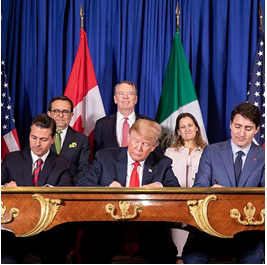
On Tuesday, the White House announced new tariffs will be put in place that are functionally the same as the tariffs struck down by the Supreme Court earlier this year. These tariffs would be a range of 10-12.5% on goods coming from more than 80 countries. The new tariffs have a federal lawsuit challenging their legality. The White House has also made statements of a desire to leave the trilateral trade deal (USMCA) with Canada and Mexico. The US has not renewed the trade deal this month, and at the same time, the use of tariffs has ramped back up. However, this does not immediately cancel the deal as the it is set to expire in 2036. Read more here and here. (Image source: Reuters)

Seattle to Charge Data Centers More for Power
The Seattle City Council has instituted a new policy to increase electricity rates for new and expanding data centers. The measure, which was unanimously voted in last Tuesday, comes on the heels of a data center moratorium instituted by the City of Seattle in June. Those against the measure have said that the policy will discourage data center companies from choosing to build in Seattle and forego the jobs that they bring, while supporters say that the increased rates for data centers will keep customers’ rates low as more data centers and infrastructure needed to accommodate them are built. Read more here.

Finland's Sand Solutions to Renewable Energy Challenges
Last year, researchers at Polar Night Energy introduced a commercial sand battery to produce heat for a Finnish town. Recent findings have indicated that the sand battery was able to reduce greenhouse gas emissions by around 70%, and the battery was able to operate for extended periods of time without the need for rare earth elements demanded by other energy technologies. Heat energy is stored in the sand through transfers of electricity from solar or wind sources via a closed-loop system. By choosing to heat the battery when prices are low and storing energy for seasons with expensive electricity prices, the sand battery is able to lower costs for residents and carbon emissions. Read more here.

EPA Lowered Pollution Regulations for Data Center Power Sources
The EPA recently announced that private facilities generating power solely for data centers are considered exempt from the Clean Air Act’s Acid Rain Program. Since they are not a part of the power grid, those plants are considered “islanded,” excluding those facilities from requirements to lower emissions of sulfur dioxide and nitrogen oxides. The lack of regulations may prompt data centers to construct their own power plants, lowering consumer electric bills. While electricity may cost less, this lack of regulation may lead to damaging environmental effects on water bodies, vegetation, and human respiratory systems. Read more here and here.

Changing Shark Movements As Ocean Temperature Reaches Record High
The largest Great White shark in the Atlantic Ocean, Contender, was spotted moving upwards towards Canada this week, reflecting a larger trend of increased shark sightings that may be due to record-high ocean temperature levels. Scientists point to sharks expanding their ranges into areas where they have historically been less common, with increased sightings reported along coastlines from California to New York. Global surface water temperatures hit a new record high last month, along with the continued development of an El Niño event affecting temperatures. Scientists also state that increased sightings do not necessarily indicate greater danger to humans but instead provide context to environmental changes as sharks play important ecological roles as apex predators. Read more here.
Data Visualization of the Week
Satellite Imagery and Machine Learning Map Wetland Conditions
In the European Union (EU), at least 30% of wetland ecosystems not in the defined ‘good condition’ must be restored by 2030 under the EU Nature Restoration Law (NRL). However, mapping the various wetland types and conditions has historically proved difficult due to a lack of consistent information on them. That has recently changed with new techniques using 10-m satellite imagery and machine learning that have revealed a pattern of fragmentation among EU wetlands. Not only were many smaller areas being missed, but they found human activities have been affecting 20.4%±3.4% of wetland areas, with different ones being impacted at differing degrees. The data visualization highlights the effect of anthropogenic disturbances on carbon storage potentials around the EU. The most disturbed areas are seen in red, intermediate disturbance seen in yellow, and the least amount of disturbance seen in green. Read more here. (Image source: Kovács et al.)


Comments